


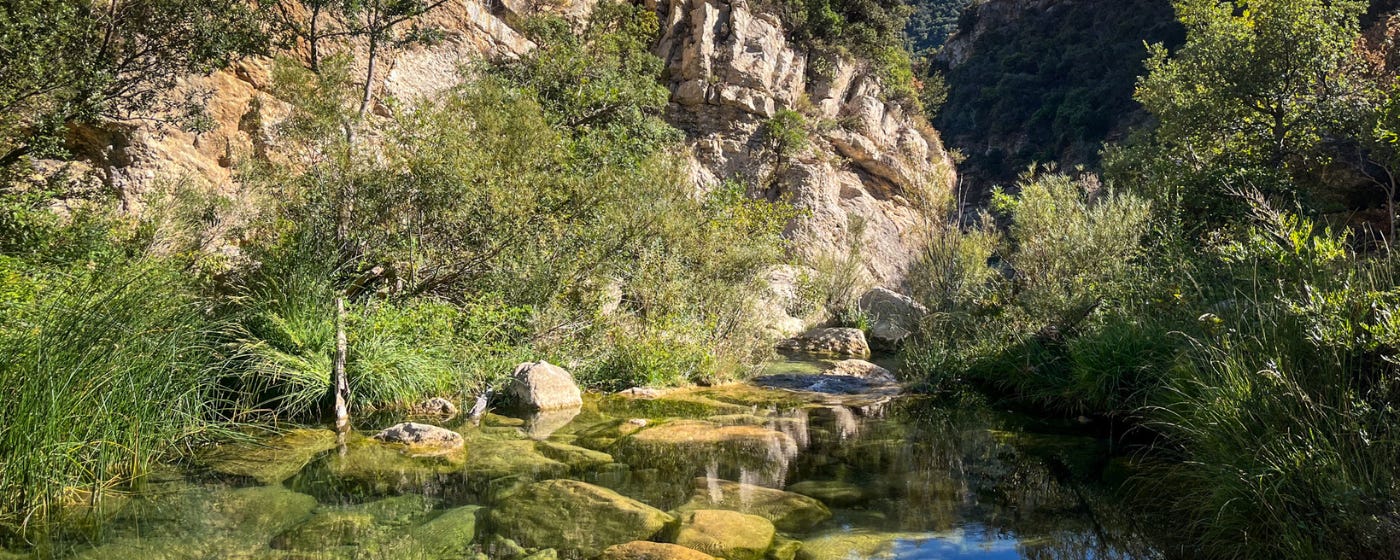
I find myself a perch, deep inside a gorge in the Corbières, to read Robin Wall Kimmerer’s essay-cum-book, The Serviceberry.
I’d seen a man along the way, face-down, browned limbs splayed, toes touching the water, all dry and salted, that elemental residue of the sun. A woman lies on a rock a little further upriver, beyond the bushes, unclothed.
The water is cold in the pools through which the river cascades — it is September, after all — and so I’d slipped out to pick a rock, flat, angled just right so I could absorb not only its retained warmth into my back, but the last of the sun on the side of my face.
Kimmerer’s book is a lovely meditation on the gift economy. Like all I have read of hers, it is generous and alive. The shadow of the gorge moves over me. I shuffle back down to the water, dip my feet into a pool. It seems even colder now. Still and clear it is, and tiny river fish move in to nibble; twenty, thirty of them. This is my gift to them, I think, and a single movement of my toes would send them scurrying. But that stillness, the cold water I dare not trouble and the facing wall of rock still glowing golden, is their gift to me too.
I am here in Maison des Aigles, my little hideaway in the French Pyrenees, to spend a few days writing. I’m working on a chapter about belonging, to whom we have bonds of belonging and responsibility, what we might owe each other.
It’s an interesting time to be thinking about all this. We are all caught up in tendrils of nature and silicon. Public opinion suddenly seems to be galvanising against the dangers of AI, asking what it’s all for, while “model welfare” has come up again. We in Europe are coming to the end of another summer of fire.
A wildfire blazed not so far away from here recently. Videos shared by residents unsteadily narrowed the frame from vast clouds to tiny planes dropping their tiny water bombs. Will they suffice, we wondered?
The drive here takes me past charred trees. What shocks me most is the total lack of undergrowth. Only ash, a kind of dirty silver. There’s too much light among the death.
But I know this can also be a seedbed for new life. Life now seems all the more precious. I see a group of firefighters, laughing together. Local folks had organised to bring them snacks and drinking water. And all the usual wildlife is still here: lizards, boars, red squirrels, bats, tawny owls, dragonflies.
A family of golden eagles circles high above the peak behind me, their young already masterful.
Before the sun becomes fierce, it stirs poetry. Long strands of tree and bush somehow tangle all the more tightly in this light, and their greens are almost yellow.
Other mornings are tempestuous, the mountain winds shaking and rattling whatever they can find.
Is it easier to write here, or harder?
In his excoriating book, Against the Machine, Paul Kingsnorth recalls an ancient Chinese distinction between “raw” and “cooked” barbarian outsiders. The raw ones live off-grid; they are few. The cooked ones probably look like upstanding citizens, who use electricity and the internet and sleep under duvets, but deep inside they are subversive. I like this. In some way, it captures what this house feels all about.
In the dead of night, the stars have depth. They are not the flecked canvas you can barely make out in cities. How small and local is all that is artificial. These nights are precious. I resent the fact that tomorrow’s will be cloudy.
The smell is often what I remember of this place. It is at its most vivid early in the morning, as I sit on the little sun-trap of a bench.
Smell is one domain that tech has yet to colonise. There is no Shazam for smells.
I wrote a little thing imagining the posthumans who are apparently to follow us, which I might include in the book.
What kind of body would you have had?
(Smell, touch, all that sort of thing)
Ha ha
Nostalgia, they would have called it
But it’s better this way
Yes, better this way
There is a rock, part of the mountain itself, that forms part of the bedroom wall. It layers buckle and curl back on themselves, a swirl of pale greys and pinks, the product of unimaginable heat and pressure. What is their story? They seem to be have been formed into rock 300 million years ago, squeezed hot in the depths of the Variscan mountains, thrown up as part of the great collision that formed the Pangaea supercontinent. If that’s correct, this rock itself is six times older than the Pyrenees of which it is now part, formed when the Iberian plate crashed and crumpled into the Eurasian plate. I run my hand tenderly along the rock and blow off a little dust.
When will I be back? Soon enough, I’m sure. But I don’t quite belong. I talk to the owner of the field behind me about his goats and the wild walnuts he is harvesting from the tree overhanging my garden. He laughs off the apology for my poor French. I seek a taker for my leftover onions and garlic. I wonder what happened to the octogenarian man opposite who came over for a coffee last year.
We all have a shared investment in this place. But my hands are not plunged into the soil as some of theirs are, or have been.
I have always been a wanderer: I am not rooted, probably never will be. I think again, as I often do these days, of Édouard Glissant and his Poetics of Relation. What if a rhizome is a better model for us than a root system; one that can take temporary root, bloom, and then shrink into itself again, ready for another season in different soil?
Nothing is permanent, as we may think. From the perspective of physics, even the mountains that surround me are just an event.
How much time does a rhizome need to flourish, I wonder? But Kimmerer’s book, lying on the coffee table, rebukes me gently. It has a different question: In its brief flourishing, what can a rhizome give?
Robin Wall Kimmerer’s The Serviceberry was published in 2024.
Maison des Aigles is available for mini-sabbaticals.